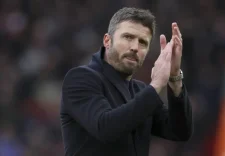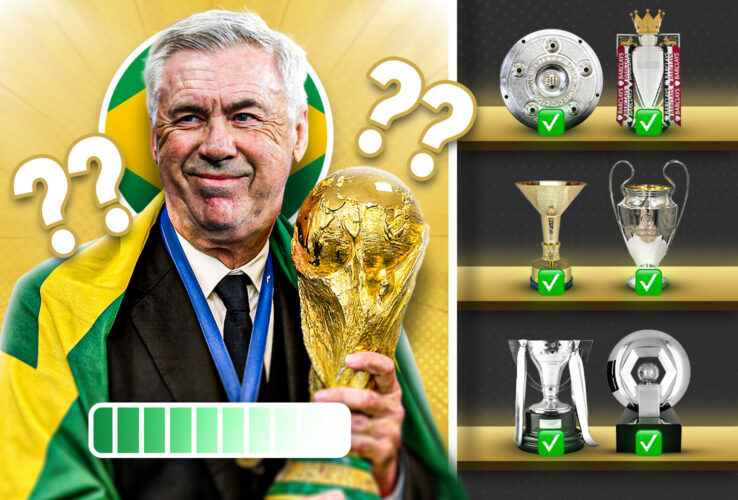
Few managers can boast a trophy cabinet quite as full as Carlo Ancelotti.
He’s won league titles in Italy, England, Spain, France and Germany, as well as having five Champions League titles to boot. He’s completed club football.
And now, as manager of Brazil, he will approach the 2026 World Cup with the opportunity to add the most coveted trophy of all – the World Cup.
Should he be successful, will Don Carlo earn the crown of being the greatest manager in history?
Ancelotti’s success has been as a result of his pragmatism. While some coaches have a fixed system – think Amorim’s 3-4-3 – the Italian has long reaped the rewards of choosing a formation and playstyle that gets the best out of the players at his disposal.
Early on in his managerial career, Ancelotti stuck to Parma’s traditional 4-4-2 set-up, a rigid system that failed to get the best out of mercurial talent Gianfranco Zola. It was the lessons from this failure that shaped how Ancelotti would adapt to the squad at his disposal.
At Milan, he utilised a now-infamous ‘Christmas Tree’ 4-3-2-1 formation that dominated the middle of the park, suffocating the opposition and played to the strengths of players such as Andrea Pirlo, Kaka and Clarence Seedorf. It’s an incredibly rare set-up, because of the difficulties in playing such a narrow formation, and the need for such specific player profiles in each position.
During his tenure at Chelsea, Ancelotti regularly deployed a different formation, changing based on player availability, form and game requirements. In his first season, a diamond midfield behind a front-two was used with devastating effect. As teams started to cotton on to how to play against this system, Ancelotti adapted to a more conventional 4-3-3 that was lethal in front of goal. On four occasions that season, Chelsea scored more than seven goals in a game.
In his first shift at Real Madrid, his 4-3-3 managed to accommodate Cristiano Ronaldo, Karim Benzema, Gareth Bale and Ángel Di María to devastating effect, guiding Madrid to La Décima in his first season in charge.
This lack of a definitive system is often used as a criticism of Ancelotti, and it would be a fair evaluation to say that this factor contributes to his average managerial tenure being less than two and half years.
Since leaving Milan, Ancelotti has been seen as a manager who can deliver quick results, but not one trusted to build a long-term system. Roman Abramovich sacked him a year after he won the double, Florentino Pérez relieved him of duties the season after winning the Champions League.
But what Ancelotti lacks in long-term success he more than makes up for in versatility. He’s the only manager to win a league title in all five big European leagues. His tactical flexibility and world renowned man management skills transcend borders and have enabled him to be successful in every league he’s managed in.
So where does this put him in the all-time rankings for greatest ever manager?
Cruyff set the blueprint. Ferguson had longevity at the top. Mourinho was special. Guardiola changed the game.
But in terms of pure ability to win, it’s hard to like past Ancelotti. A World Cup victory will cement his status as the best ever.