It’s easy to look at modern football and wonder if we’ve lost something.
Every pass is calculated, every sprint tracked, every shot analysed to the decimal.
Even the fans talk in data – imagine explaining xG to a football fan from the 90s.
The modern player is fitter than ever; they run further, press harder and play at higher intensity.
But has this come at the expense of football’s soul?
Data analysis, sports science and tactical modelling have made football smarter and more efficient. But that precision has come at the cost of spontaneity.
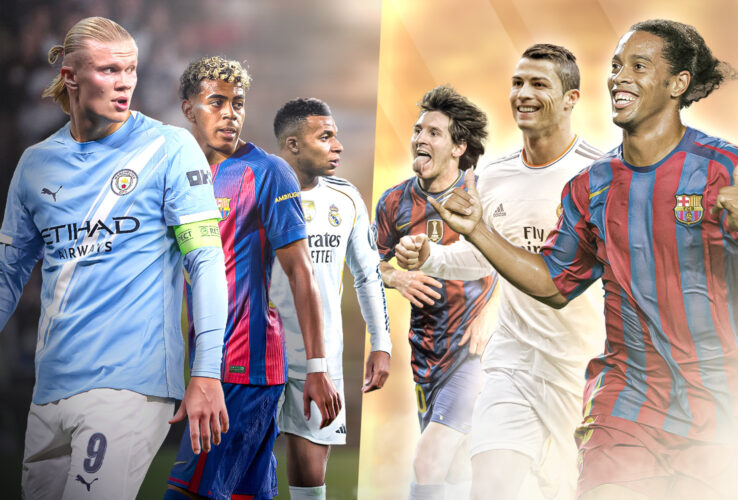
Once, players like Ronaldinho, Gascoigne and Okocha ruled through instinct. They weren’t bound by positional grids or heat maps; they did things with the ball no one could predict.
Guardiola and Arteta are the archetypal managers who have perfected the art of a tactical machine where every movement is rehearsed. It’s certainly effective, but it is clinical in nature. A perfect pass matters more than a crowd-pleasing trick.
Decision-making has become optimised, not improvised.
And that leads some fans to say the game’s gone.
Has it though?
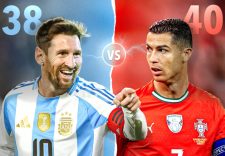
The Messi and Ronaldo era has distorted things somewhat. Their rivalry was an anomaly; two generational outliers dominating football for fifteen years. When that era ended, the sport naturally felt flatter. But that doesn’t mean the overall quality has declined. Players like Mbappé or Haaland aren’t on the level of Messi or Ronaldo in their prime, but they are still outstanding footballers.
The same can be said for the recent winners of the Ballon d’Or. Some complain that recent winners like Rodri or even Dembélé aren’t as deserving as past greats. But look back to before the Messi and Ronaldo era; did Pavel Nedvěd, Fabio Cannavaro or Andriy Shevchenko really stand that far above today’s top performers?
The truth is that the Ballon d’Or has always been inconsistent. What’s changed is that team success now weighs more heavily than individual performances. That’s not necessarily a reflection of the lower quality, just a different emphasis.
When fans say the game is gone, one argument that does hold weight is that football feels less human. The unpredictability has been replaced by the drive for perfection.
This isn’t to say today’s players lack talent. Far from it.
Bellingham, Vinícius and Yamal prove that creativity can still thrive even in the most system-driven environments. Coaches who give players freedom are becoming rarer, but when they do, it is a sight to behold. Jack Grealish’s resurgence at Everton has reminded everyone what a creative force he can be when not required to recycle possession at every opportunity.
Watch Real Madrid, Barcelona or PSG and you’ll still find drama, flair and footballing brilliance in abundance. The past two seasons of El Clásico have had everything football is supposed to have; storylines, chaos and pure emotion.
Football has always evolved, and it would be wrong to reject that. From a purely sporting perspective, you could make the argument that the game has never been stronger across the board.
However, the growing commercialization is certainly affecting things like fan culture and club identity. Players are changing clubs more often, teams rarely have a clear playing philosophy and clubs are run either as businesses or as a billionaire’s plaything.
The European diversity that once existed is fading as big clubs like Milan, Ajax and Benfica are forced to sell their best players to mid-table Premier League sides. The looming threat of the Super League would destroy the competitive spirit that European football has been built on for decades.
The game isn’t gone, but it isn’t what it was – for better and worse.