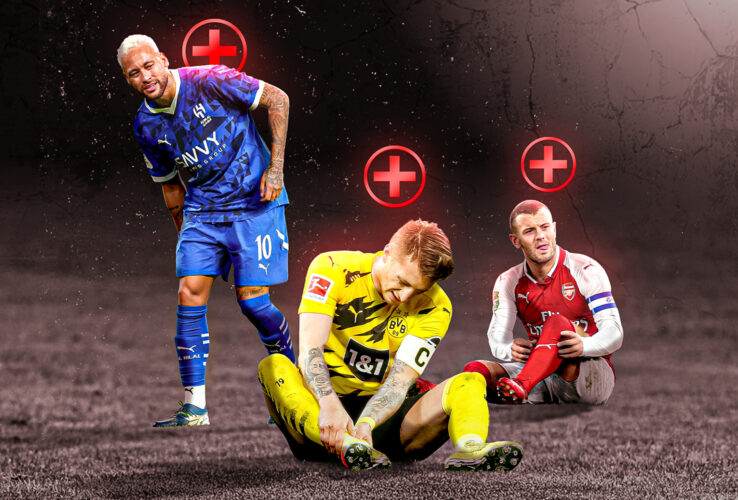
Injuries are the great equaliser in football.
They cut down icons in their prime and derail careers before they’ve even peaked.
Some players bounce back and adapt, while others never quite recover.
We’ve ranked ten footballers whose careers were most heavily defined, and in some cases destroyed by their time on the treatment table.
10) Reece James
The English right-back is still at the stage where the long-term story of his career isn’t written – but the early chapters are worrying.
Since breaking through at Chelsea, he has been hampered by recurring hamstring injuries, knee problems and muscular strains. When fit, James is one of the Premier League’s most complete full-backs. Powerful, technically sharp and effective in both boxes.
His inability to string together long runs of games has already raised questions about whether his body can cope with the demands of elite football.
9) Neymar
Neymar’s career has been peppered with regular injuries rather than dominated by one single catastrophic moment. Since joining Barcelona in 2013 and then PSG in 2017, he’s endured ankle ligament ruptures, metatarsal fractures and an ACL injury.
These injuries have often come at the worst times for club and country, whilst also disrupting his attempts at mounting a serious Ballon d’Or challenge.
Despite the injuries, Neymar was able to rack up elite-level numbers and silverware. His case differs from some of the other players on this list as he was still able to live up to his potential. He is a player frequently on the sidelines but was still amongst the world’s best when he was at his peak. His career will be looked back on with a mix of brilliance and frustration.
8) Daniel Sturridge
During his peak under Brendan Rodgers in the 2013-14 season, Sturridge looked every inch a world-class striker. He was quick, clinical and intelligent in his movement. His fearsome partnership with Luis Suárez was never enough to win a league title, but it terrified Premier League defences week in, week out.
From 2014 onwards, a series of injuries cut into his pace, rhythm and confidence.
Persistent thigh and hamstring injuries coupled with hip issues saw him miss a large chunk of multiple seasons. Each return was met with new setbacks, stopping him from ever regaining that devastating form.
Short spells at West Brom, Trabzonspor and Perth Glory followed, but injuries and fitness concerns lingered. Sturridge’s story is a reminder of how quickly an elite player can disappear from the limelight when their body refuses to cooperate.
7) Michael Owen
Owen exploded onto the scene as a teenager with Liverpool and England. He was the Mbappé of the 90s – quick, direct and clinical.
Hamstring injuries began to slow him down in his early twenties. The most damaging injury blow came in the 2006 World Cup when he ruptured the cruciate ligament in his knee just a minute into the group stage game against Sweden.
The layoff was nearly a year. Whilst he continued to score goals afterwards, the burst of pace that once defined him was gone.
Later seasons were plagued by smaller muscular injuries, leading to an early retirement at 33.
Owen’s career shows how one major injury, followed by regular repeated smaller ones, can completely alter a player’s style and effectiveness.
6) Eden Hazard
At Chelsea, Hazard was almost ever-present and rarely injured.
In his four seasons at Stamford Bridge, he missed just 26 games through injury. Following his big money move to Real Madrid, he missed 26 games in his debut season alone.
It was during a Champions League group match against PSG in November 2019 that a heavy challenge left him with a fractured ankle. Surgery followed, but complications and repeated muscle injuries kept him in and out of the team. This stop-start nature of his Madrid career disrupted his rhythm, confidence and sharpness.
By 2023, Hazard had left Real Madrid with only flashes of the player who had lit up the Premier League. Injuries were the main factor in his failure to succeed in Spain.
5) Marco Reus
Reus has sadly become synonymous with ill-timed injuries.
His blend of pace, creativity and finishing made him Borussia Dortmund’s talisman, but fitness problems have regularly cut down his seasons.
In 2014, he missed Germany’s World Cup triumph following an ankle ligament issue suffered in a warm-up match. Hamstring tears, knee ligament strains and persistent muscular issues followed, costing him appearances in Euro 2016 and limiting his league campaign.
Despite these injuries, Reus still put in impressive performances in yellow and black. His situation is of a player being good enough to come back time and again, but never able to sustain elite form over multiple full seasons.
4) Jack Wilshire
Wilshere’s early Arsenal career promised the arrival of England’s midfield conductor for the next decade. His performance against Barcelona in the Champions League aged just 19 is legendary.
Recurring ankle injuries became the constant backdrop to his career. Every attempted run of games was cut short by another setback.
His time at West Ham and Bournemouth saw flashes of ability, but the physical demands of top-level football repeatedly broke him down. By 30, Wilshire had retired and moved into coaching.
3) Ronaldo
R9’s prime years remain some of the greatest ever seen on a football pitch.
By 22, he was already a two-time Ballon d’Or winner following incredible success with Cruzeiro, PSV, Barcelona, Inter Milan and Brazil.
In November 1999, Ronaldo ruptured the tendons in his right knee, sidelining him for five months. His comeback lasted just seven minutes before his knee gave way again. These two patellar tendon ruptures saw R9 on the sidelines for 665 days, missing 119 games for club and country. A repeat of this knee injury in 2007/08 drew the curtains on his club career in Europe.
Although he managed prolific spells at Real Madrid and AC Milan, Ronaldo never regained the electric acceleration of his early days. His resilience and time at the top was extraordinary, but those injuries robbed the sport of the most devastating version of “O Fenômeno.”
2) Abou Diaby
What a midfield Arsenal could have had if Jack Wilshire and Abou Diaby were able to avoid injury and hit their promised peak.
Diaby looked like the perfect modern midfielder when he signed for Arsenal in 2006. Tall, skillful and quick, he looked to fill the midfield void left from Patrick Vieira’s departure.
A horror tackle against Sunderland fractured his ankle and damaged ligaments – an injury that set the tone for everything to come. Diaby returned but was never able to put together a full season without setbacks.
Between 2006 and 2015, Diaby made just 124 league appearances for Arsenal. After a brief spell with Marseille, he called time on his career aged just 32.
1) Marco van Basten
Van Basten’s career is the textbook example of how injuries can rob the game of greatness.
Aged just 28, chronic ankle issues forced him into early retirement, ending a career that had already brought three Ballon d’Ors.
The injury problems began in the late 1980s, aggravated by the physical style of defending in the Serie A at the time. Multiple operations gave a brief reprieve, but the damage was never fully cleared. His final competitive game came in the 1993 Champions League final.
Van Basten still stands amongst the world’s greatest ever strikes, but the what-if factor still looms over his career. Should he have been able to stay at his peak for longer, he likely would have rewritten all of the goalscoring records.